The CryptKi Guides
How to buy and sell cryptocurrencies: beginner’s guide
You might be thinking: “Why not me?”
A friend, your neighbor, your sister, a colleague… everyone has been talking about it for months. And now the moment has come, but where do you start?
First, know that you’re in the right place on CryptKi. The goal here is simple: help you understand what you’re doing, so you can avoid the most common mistakes.
Buying cryptocurrencies is often presented as something simple. In practice, when you’re just getting started, creating an account, depositing money, and clicking “buy” is far less straightforward than it seems.
Behind this seemingly simple action lie several important decisions. Those decisions will directly impact the security of your funds, the fees you pay, and your ability to use or recover your crypto later.
In this article, we’ll walk through how to buy and sell cryptocurrencies, the different options available to you, and most importantly what actually happens at each step.
👉 If some of these terms are still unfamiliar (wallet, private keys, blockchain…), we recommend starting with the Academy:
Before you start: three things to decide
Before creating an account anywhere, decide three things:
- How much you want to start with?
- which cryptocurrency you want to buy?
- And whether you want to keep it on the platform or withdraw it to your own wallet.
These choices affect the platform you choose, the fees you pay, and the mistakes you need to avoid.
Choosing a platform to buy crypto
The first step is choosing a platform that allows you to convert fiat money, meaning traditional currencies issued by governments like euros or dollars, into cryptocurrencies.
This is an important decision. Not all solutions work the same way, whether in terms of cost, features, or security. Broadly speaking, there are three main categories.
This status can be useful to understand the legal framework that applies, but it should not be treated as a guarantee of safety or quality. Regulation is one signal among many, alongside reputation, fees, custody model, withdrawal options, and transparency.
Centralized exchanges (CEX)
Some of the most well-known include Binance, Bybit, Coinbase and Kraken.
These platforms allow you to easily buy and sell cryptocurrencies while offering access to a wide range of assets, from Bitcoin (BTC) to more speculative tokens.
They are also designed for trading. More advanced users will find complex tools and additional features.
In practice, they offer much more than simple buying. Payment cards, staking, investment products… these options can be useful, but also confusing at first.
Their main advantage is relatively low fees.
Their main drawback is that the interface can be difficult for beginners to navigate. Even if some of them offer simplified interfaces for non-traders.
Your choice of platform may also depend on the cryptocurrency you want to buy. Some "exotic" tokens are only available on specific exchanges, especially less common or more recent ones. This is not investment advice, but it’s worth being cautious with less common tokens and newer or lesser-known exchanges that have not yet proven their reliability. In practice, the risks of loss are generally higher.
👉 Always check whether the platform supports the asset you’re looking for before creating an account or depositing funds.
👉 List of CEX platforms:
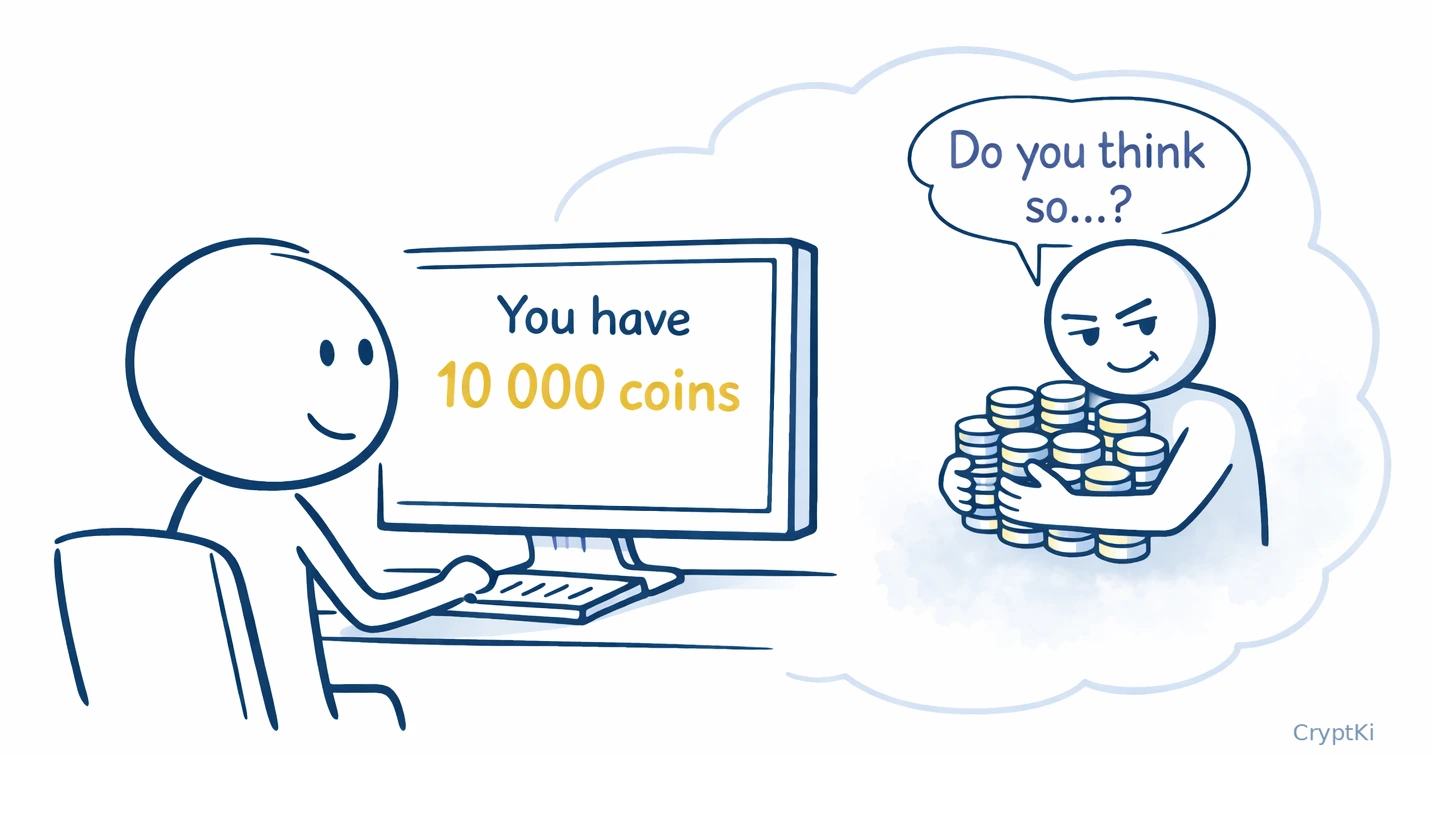
How it works in practice
Create your account.
You start by creating an account. You provide an email address, set a password, and enable two-factor authentication. Most platforms require it, and it is strongly recommended regardless.
Then comes the KYC (Know Your Customer) procedure. You will usually be asked to upload a government-issued ID, and often complete a selfie or short live face verification. Some platforms may also request additional information such as your residential address, proof of address, or basic questions about the source of your funds and intended account use.
On most major exchanges, verification takes anywhere from a few minutes to a few days, depending on the checks involved. Until it is approved, your account is usually limited or inactive.
Deposit funds.
Once verified, you deposit funds. The standard method is a bank transfer (SEPA in Europe), which is generally free or very low cost. Card payments are faster but come with higher fees. Some platforms also support Apple Pay, Google Pay, or local payment methods.
Your fiat lands in what is usually called your Spot wallet. This is the part of the account reserved for direct asset purchases, as opposed to futures or margin accounts, which are advanced trading products intended for experienced traders and not for a straightforward crypto purchase. Before moving to the next step, check that the balance is correctly reflected.
Buy your crypto.
Now you can buy. Navigate to the trading section and search for the trading pair you want. A trading pair is the combination of the asset you want to buy and the currency you are using to buy it. For a first purchase, you will look for a pair that includes your fiat currency: BTC/EUR to buy Bitcoin with euros, or ETH/EUR to buy Ethereum. Once you have selected your pair, you choose your order type.
A market order executes immediately at the current price. It is simple and fast, but the price you get may differ slightly from what you saw on screen, especially if the asset has low liquidity or the market is moving quickly.
A limit order lets you set the price you are willing to pay. Your order sits in the order book and executes automatically when the market reaches your price. It gives you more control, but if the price never reaches your level, the order stays open until you cancel it.
Once your order is filled, the crypto appears in your portfolio. From there, you can hold it on the platform, send it to your own wallet, or sell it.
💡 Bank transfers are usually the cheapest way to fund your account. Card payments are faster but cost more. For larger amounts, the difference adds up quickly.
💡 Some CEX platforms offer reduced trading fees if you hold a small amount of their native exchange token. BNB on Binance is the most well-known example, but other exchanges have similar mechanisms. Worth checking before you start trading.
⚠️ Make sure you are on the Spot interface, not the Futures or Margin sections. Those involve leverage and carry a very different level of risk.
Brokers and simplified buying apps
Some services, such as SwissBorg or Bitpanda, Meria, and Coinhouse, take a different approach by focusing more on simplicity than on active trading. Their goal is not to offer a trader-style interface, but to make buying crypto easier, often through a cleaner mobile or web experience.
Some of them also offer access to additional products or services. This can be useful in some cases, but may also add confusion when you are just getting started.
These platforms may include features such as staking or crypto portfolios, which can help if you are not sure how to allocate your funds.
The trade-off is usually higher fees.
👉 They are often suitable for beginners, or for users who want a simple buying experience, but less suited to advanced trading.
Some banking and fintech apps also let users buy and sell crypto directly. Examples include Revolut, N26, and Trade Republic, which focus on convenience and ease of access.
Deblock takes a different approach. Rather than offering only custodial crypto access, it combines a payment account with true self-custody features, meaning you control your wallet keys rather than relying entirely on the platform. This is unusual among banking-style crypto apps, and an important distinction.
The important point is not the category name. It is whether you can withdraw the crypto, who controls the keys, what fees apply, and which networks are supported.
How it works in practice
You create an account, complete KYC, and deposit funds by bank transfer or card, depending on the platform.
To buy, you select the asset, enter the amount in fiat, and the platform shows you what you will receive including fees. Most brokers automatically route your order across multiple liquidity sources to find the best available price. You confirm, and the transaction executes at market price.
Some brokers also offer trigger orders or savings plans, which let you set a target price or invest a fixed amount at regular intervals. When the market reaches your level, the order executes automatically.
Your assets appear in your portfolio immediately after execution.
The exact flow depends on the type of service. A crypto broker usually gives you an internal portfolio and may allow withdrawals to an external wallet. A banking or investing app may focus mainly on buying and selling inside the app, with more limited withdrawal options depending on the asset, country, and network.
Some newer services combine payment features with wallet functionality, including self-custody models where users control their own keys. This is still uncommon, but it highlights an important point: not every service offering crypto gives you the same level of ownership or control.
"Direct-to-Wallet" gateways (on-ramp services)
Some services allow you to buy crypto without using a traditional exchange. Examples include Mt Pelerin, Ramp Network, MoonPay, and Transak.
The concept is simple. You make a payment — by bank transfer or card — and the crypto is sent directly to your wallet.
This has several advantages. First, simplicity. Second, in some cases, the ability to buy small amounts without identity verification. And most importantly, you control your funds directly.
This reduces custody risk because the crypto is sent directly to your own wallet. It does not remove the need to check the address, network, and fees carefully.
But convenience comes at a cost. Fees are usually higher than on exchanges.
⚠️ These solutions require you to already have a wallet. If you don’t have one yet, take a look at our article: How to set up a crypto wallet
⚠️ In all cases, each service has its own rules. Fees, limits, supported countries, and features can vary significantly. Take the time to compare before making your choice.
How it works in practice
You open the service and select the cryptocurrency you want to buy and the blockchain network on which you want to receive it. This second choice matters: the same token can exist on multiple networks, and sending to the wrong one can result in a loss.
You enter your wallet address. This is where the crypto will be delivered. Double-check it carefully before proceeding. Some services allow you to connect your wallet directly to avoid typing the address manually.
You choose a payment method: bank transfer or card. Bank transfer is generally cheaper and sometimes does not require identity verification for small amounts. Card is faster but costs more.
You make the payment. For card purchases, you enter your card details and confirm. For bank transfers, you receive the service's bank account details and send the fiat from your own bank.
Once the payment is received, the crypto is delivered to your wallet. Delivery typically takes a few minutes for card purchases and up to a few hours for bank transfers, depending on network congestion.
💡 Bank transfers are typically the most cost-effective option. Card purchases are faster but carry higher fees. At the time of writing, card fees on most on-ramp services range from around 1.5% to 3%, but these figures change regularly. Always check the current fee before confirming your purchase.
⚠️ Always verify the network before entering your wallet address. Receiving a token on the wrong network can result in funds that are difficult or impossible to recover.
⚠️ You must already have a wallet set up before using these services. The gateway delivers to your address but does not create or manage a wallet for you.
Why platforms require identity verification (KYC)
Most platforms now require identity verification, known as KYC : “Know Your Customer”. In practice, this means providing certain personal information. This process has become standard across the financial industry. Banks follow similar rules. It helps platforms comply with regulations, especially those related to anti-money laundering. However, it also means that your activity on the platform is directly linked to your identity.
⚠️ Alternatives without KYC do exist. They are often more limited, sometimes more expensive, and may not be available or fully compliant depending on your country. You should always make sure they are compatible with the rules that apply where you live.
Depositing funds and buying crypto
Once your account is set up, you can deposit funds. This can be done via bank transfer (SEPA), card payment, or sometimes through Apple Pay or Google Pay depending on the platform.
Each method comes with its own delays and fees.
But the most important point is what happens when you buy. Because contrary to what many people think, the displayed price is not always the real price.
Some platforms advertise “zero fees”, but actually make money through what is called the spread. This is the difference between the price they offer you and the real market price.
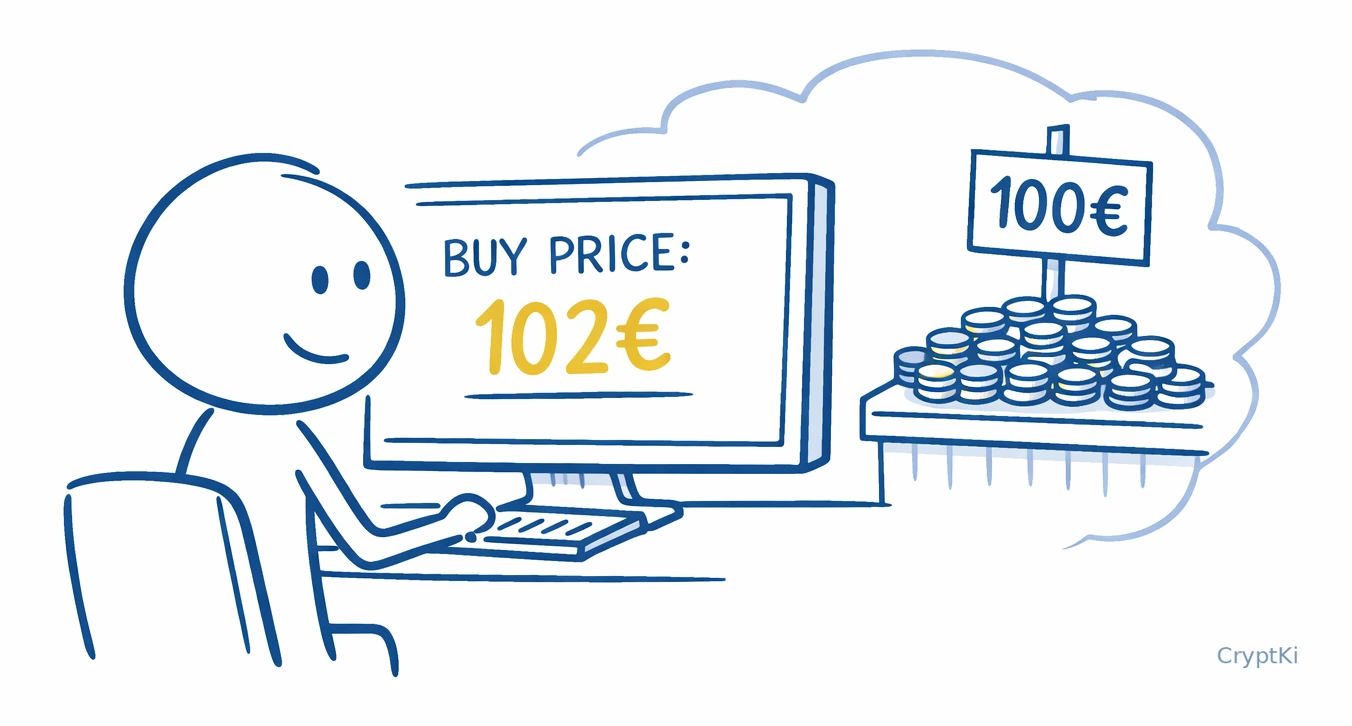
In practice, you buy slightly above the market price, and sell slightly below it. The difference is their margin.
This mechanism is subtle, but very real.
Depending on the platform, you will also be able to choose between two types of orders:
- a market order, executed immediately at the current price
- a limit order, executed only when the price reaches a level you define
⚠️ For large amounts, a market order can move the price if there are not enough buyers or sellers available at that moment. This is known as a lack of liquidity.
Choosing what to buy is often where the first mistakes happen.
Not all cryptocurrencies carry the same level of risk. Well-established assets like Bitcoin or Ethereum have a longer track record, deeper liquidity, and are available on virtually every platform. Others may be newer, less liquid, or only listed on a handful of lesser-known exchanges. That combination of limited access and lower reliability adds risk that is easy to underestimate at the start.
But risk is only part of the picture. What matters just as much is what you actually understand. Buying an asset without knowing how it works, why it exists, or how to use it often leads to poor decisions under pressure.
⚠️ A common mistake is to choose a cryptocurrency based only on its recent price, past performance, or what others are saying. This approach tends to increase risk rather than reduce it.
This is not investment advice. But in practice, starting with assets that are widely supported, easy to store, and well documented can help reduce unnecessary complexity and avoid early mistakes.
A strategy to manage risk of volatility: DCA
Cryptocurrency prices can move significantly in a short period of time. A price drop of 20, 30, or even 50 percent within a few weeks is not unusual in this market. This is what volatility means in practice, and it is one of the first things to understand before investing.
When starting out, a common question comes up. Should you invest everything at once, or gradually over time?
Investing a lump sum, meaning everything at once, is straightforward, but it exposes you entirely to the market price at that specific moment. If the market moves against you shortly after, the impact can be significant.
An alternative is DCA, or Dollar-Cost Averaging. This means investing a fixed amount at regular intervals, for example every month.
If the price drops, you buy more crypto for the same amount. If it rises, you buy less. Over time, this helps smooth out your average purchase price and reduces the impact of volatility.
💡 Many platforms offer this feature automatically.
What you are actually buying
A common misunderstanding is about what you are really purchasing.
In some cases, you are buying actual cryptocurrency that you can withdraw to your own wallet.
In other cases, you are only buying exposure to the price through a derivative product. You are effectively betting on the price, without owning the asset itself.
👉 Simple rule: if you cannot withdraw your crypto to your own wallet, you probably do not truly own it.
Leaving your funds on a platform: an underestimated risk
After buying, your funds usually remain on the platform. This may seem convenient, especially at first.
But it implies something critical. You do not control the private keys. In other words, you rely entirely on the platform to access your funds.
👉 This is summed up by the well-known expression: “Not your keys, not your coins”.
In practice, withdrawals can be blocked, the platform can be hacked, or the company can go bankrupt. Events that may seem unlikely, until they happen.
👉 To understand why:
Selling cryptocurrencies (off-ramp)
Selling is simply the reverse process.
If your crypto is stored in a wallet, you will first need to send it to a platform. Then you can convert it into fiat currency and withdraw the funds to your bank account.
The same constraints apply. Fees, delays, and possible restrictions depending on your country.
⚠️ In some cases, these actions may be considered taxable events.
A commonly overlooked topic:
TAXATION
Crypto taxation depends entirely on the country you live in. Rules can vary significantly from one jurisdiction to another.
In general, certain actions may be taxable:
- selling crypto for fiat
- converting one token into another
- paying with crypto
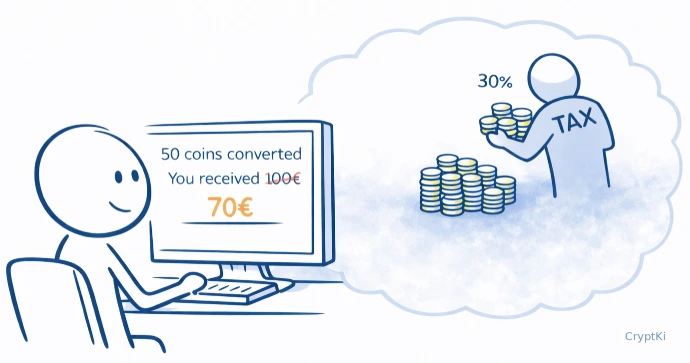
In some countries, even swapping Bitcoin for Ethereum can trigger a taxable event. In most cases, platforms do not handle your tax obligations for you. Even where automatic reporting rules are being introduced in Europe, the responsibility for keeping records and declaring taxable events remains yours. Keeping a clear record of your transactions from the start is not optional. It is the only way to avoid problems later.
👉 It is essential to check local regulations before acting, or consult a professional if significant amounts are involved.
Key takeaways
- Buying crypto almost always involves an intermediary platform
- Not all platforms sell the same type of assets
- Fees often include hidden components such as the spread
- Leaving funds on a platform means you do not fully control them
- DCA helps reduce the impact of price volatility
- Buying and selling are symmetrical processes
- Taxation exists and varies depending on your country
Find out more on CryptKi Academy
-
What is a cryptocurrency
To understand what a crypto asset actually is. -
Risks in the crypto ecosystem
To see how misunderstandings and misuse lead to real-world losses. -
What is a crypto wallet?
To clarify what wallets do, and what they never do. -
How to set up a crypto wallet
To understand how to set up a wallet correctly from the start. -
How to move crypto off an exchange safely
To understand what changes when you withdraw crypto to your own wallet.
CryptKi Academy full index - Browse all articles
Glossary - Check the definition of all specific terms
Self-custody starts with the right setup.
Explore hardware wallets, seed phrase backups, and accessories designed to help protect your crypto access.