The CryptKi Guides
How to move crypto off an exchange safely
Buying crypto on an exchange is easy. Leaving it there is easy too. That is exactly why many people do it for longer than they should.
As long as your funds stay on an exchange, the platform controls the keys. You may see a balance, but that does not mean you control the assets directly.
Moving crypto off an exchange is where that changes, and where a new category of mistakes appears: wrong network, wrong address, unsupported asset, or withdrawals sent somewhere you did not intend.
This guide focuses on that exact step. Not on buying crypto, and not on sending crypto in general, but on what you need to understand when you withdraw assets from an exchange to a wallet you control.
👉 If some of these concepts are still unclear, start here first:
→ What is a crypto wallet?
→ How to set up a wallet
→ How to send and receive crypto safely
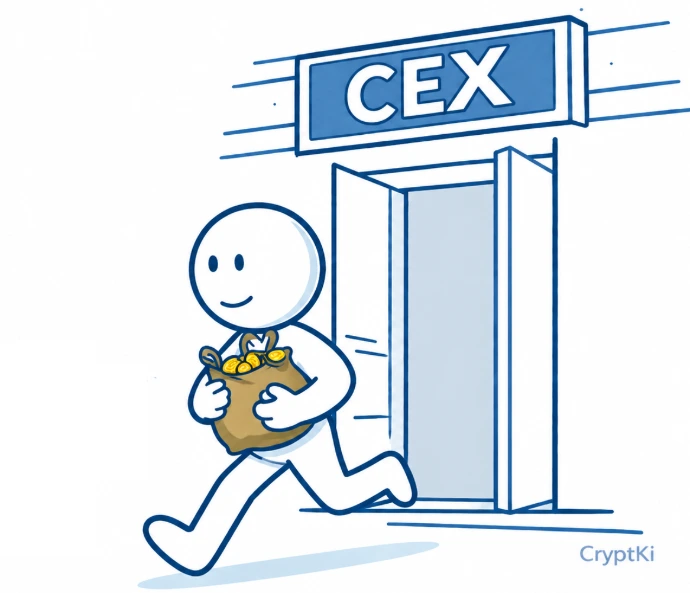
Why move funds off an exchange
An exchange is useful for buying, selling, and sometimes swapping assets quickly. It is not the same thing as self-custody.
As long as your crypto stays there, the exchange remains the actual controller of the keys. That means access depends on its systems, its policies, and its ability to process withdrawals when you ask for them.
Most of the time, that feels invisible. You log in, you see your balance, and everything looks normal.
But the important question is not whether the interface works. It is whether you could still access your assets if the platform freezes withdrawals, limits your account, gets hacked, or simply becomes unavailable at the wrong moment.
Moving funds off an exchange is how you go from platform access to actual control. That does not remove risk. It changes where the risk is.
A point to think about before withdrawing
Withdrawing crypto is not always just a technical action.
In some countries, moving assets itself is not taxable. In others, the withdrawal may not be the taxable event, but the transactions before or after it may be. Sometimes the issue is not the withdrawal, but whether you can still document the origin, cost basis, or transaction history clearly afterward.
That means one practical rule matters before you start: know whether this withdrawal has accounting or tax consequences where you live, or whether it changes what records you need to keep.
This article is not tax advice, but it is worth checking local rules before moving significant amounts.
Step 1. Make sure your wallet is ready to receive
Before initiating any withdrawal, confirm that your wallet is actually ready.
Do not withdraw meaningful funds to a wallet until your seed phrase has been backed up and checked. Moving funds to a wallet you cannot recover is not self-custody. It is a new risk.
That means the wallet is set up correctly, you have access to it, you are on the correct network, and you know which asset address you are copying.
This is where many mistakes begin. Not because people choose the wrong exchange option, but because they assume "my wallet address" is one universal destination for everything. It is not. The correct receiving address depends on the asset and the network.
👉 Example: you want to withdraw USDT from an exchange. The exchange offers Ethereum, Tron, Arbitrum, and other networks. Your wallet may support some of them, not all of them, or not in the same way. If you choose the wrong one, the withdrawal may arrive somewhere you did not intend, or become difficult to recover.
Do not start from the exchange side first. Start from the wallet side. Open the wallet, select the asset, check the network, then copy the receive address.
Step 2. Check the network before the address
Many users focus on the address first. In practice, the network choice is just as important.
The same asset name can exist on several networks. Exchanges often list them all in the withdrawal screen. If you move too quickly, it is easy to select the wrong one, especially when the labels look familiar.
👉 Example: you want to withdraw ETH to Arbitrum, but you select Ethereum mainnet by mistake. The address may look compatible, but the funds will not arrive in the network context you expected. Or the reverse: you intend to withdraw on Ethereum, but choose a cheaper alternative network without realizing your receiving wallet or your future use case does not match that choice.
This is one of the most common withdrawal mistakes because the interface makes it look like a fee choice, when it is really a network choice.
⚠️ A cheaper withdrawal fee does not help if the asset arrives on the wrong chain.
Step 3. Review the withdrawal details carefully
Once the wallet and network are confirmed, you can begin the withdrawal on the exchange.
The exact interface differs from one platform to another, but the logic is always the same. Take a moment to verify the asset you are sending, the receiving address, the selected network, the amount you will send, and the amount that will actually arrive after fees. Also confirm any required security checks such as email confirmation, 2FA, or device approval.
Every field matters. This part feels administrative. It is not trivial.
Some exchanges show warnings when the address format does not match the selected network. Treat those warnings seriously.
If the exchange supports a withdrawal whitelist or trusted address list, using it can reduce future copy-paste risk once the address has been verified properly.
A whitelist only helps if the saved address is correct in the first place. Verify it carefully before trusting it for future withdrawals.
Step 4. Understand the fees before you confirm
Exchange withdrawals usually involve a fixed fee or a network-dependent fee. That fee is not the same as gas in your wallet. It is the exchange's withdrawal fee for sending the transaction.
Sometimes the fee is reasonable. Sometimes it is surprisingly high relative to the amount being withdrawn.
Also check whether the exchange or receiving platform applies a minimum withdrawal or minimum deposit amount. If you send less than the minimum, the funds may not be credited automatically.
👉 Example: you withdraw a small amount of an asset on Ethereum mainnet. The network fee chosen by the exchange may be large enough that the withdrawal no longer makes sense economically. That is why small balances are often where people first notice network cost differences.
Before confirming, check how much the exchange will deduct, which network you are paying for, whether the amount left after fees still makes sense, and whether another supported network fits your wallet and your intended use better.
⚠️ Never choose a network only because the fee is lower. The correct network matters more than the cheap one.
Step 5. Expect delays, and know what kind of delay it is
A withdrawal is not always immediate. There are at least three possible waiting periods: the exchange may take time to process the withdrawal internally, the blockchain transaction may take time to confirm, and the receiving wallet may need the correct network selected or the token manually displayed before showing the result clearly.
“Completed” on the exchange usually means the exchange has sent the transaction. It does not always mean the funds are already visible in your wallet.
That means "not visible yet" does not mean "lost".
👉 Example: you confirm the withdrawal. The exchange marks it as pending for several minutes. Later it shows as completed, but your wallet still displays nothing. You then check the blockchain explorer and realize the funds are already there, but your wallet has not refreshed yet or the token is not visible by default.
The correct reflex is not panic. The correct reflex is to check the withdrawal status on the exchange, get the transaction hash if available, verify it on the correct block explorer, and confirm that your wallet is on the correct network.
A delay is a situation to verify, not automatically a problem.
Step 6. Start with a small test withdrawal when it matters
If you are sending to a new wallet, using a new network, or moving a meaningful amount, a small test withdrawal is often worth it.
This is especially true when the destination address is new, the chosen network is unfamiliar, the asset exists on multiple networks, or the full withdrawal would be painful to lose or misroute.
👉 Example: instead of sending the full balance immediately, you withdraw a small amount first. It arrives correctly. You then repeat the process with the rest.
Yes, this may cost an extra withdrawal fee. But that fee is often much smaller than the cost of an irreversible mistake.
⚠️ A test withdrawal is not a sign of uncertainty. It is a deliberate way to reduce it.
Step 7. Verify reception correctly
Once the withdrawal is marked as completed, do not stop at "the exchange says sent". You still need to verify reception.
That means checking that the funds reached the correct address, that they arrived on the correct network, that the asset shown in the wallet is the one you expected, and that the amount received matches what should have arrived after fees.
A blockchain explorer is often the best source of truth here. The wallet interface is useful, but the explorer confirms what happened on-chain.
👉 Example: your exchange confirms the withdrawal. Your wallet still shows no balance. You check the explorer with your address and see the funds did arrive. The issue is not the transfer. It is how the wallet is displaying the asset. That distinction matters. The transfer can be correct even when the wallet view is incomplete.
The most common mistakes
Most withdrawal mistakes are simple. Users copy the wrong address, choose the wrong network, underestimate the withdrawal fee, send a full amount without testing first, or assume the wallet is ready when it is not.
Others see a cheaper network on the exchange and choose it without checking whether their wallet and future use actually match that choice.
These are not advanced failures. They are ordinary mistakes made in familiar-looking interfaces. That is why they are so common.
Before you confirm
Moving funds off an exchange is often described as a security upgrade. That is true, but only if the withdrawal is done correctly.
Leaving funds on an exchange means trusting the platform. Moving them to your own wallet means taking responsibility for the destination, the network, and the recovery conditions yourself.
That shift is the point. The goal is not just to withdraw funds. It is to understand where they are going, and who controls them once they arrive.
A final note
Wallet interfaces, blockchain tools, and platform procedures change over time. The guidance in this article reflects common practices, but your specific wallet, platform, or network may work differently.Before taking action, always verify the current steps through official documentation and trusted sources relevant to your situation.
Never rely on a single source when the consequences are irreversible.
Key takeaways
- Moving funds off an exchange changes who controls the keys
- Start from the wallet side — confirm the asset, network, and address before touching the exchange
- The correct network matters more than the cheapest fee
- A withdrawal is not just an address field. It is also a network choice.
- A test withdrawal is often worth the extra cost
- Delays are normal — verify with a blockchain explorer before assuming something is wrong
- The withdrawal is only complete when the funds are confirmed in the right place
Find out more on CryptKi Academy
-
What is a crypto wallet?
To understand what changes when you move from platform access to self-custody. -
Centralized exchange risks: custody and exposure
To understand what you are exposed to when the platform controls the keys. -
How to set up a wallet
To make sure the destination wallet is ready before withdrawing anything. -
How to send and receive crypto safely
To understand what to verify once your funds leave the exchange. -
How to swap and bridge assets safely
To understand what happens next when you start using your crypto on-chain. -
Wrong network or wrong chain: common mistakes
To see how funds can be sent correctly to the wrong place.
CryptKi Academy full index - Browse all articles
Glossary - Check the definition of all specific terms
Self-custody starts with the right setup.
Explore hardware wallets, seed phrase backups, and accessories designed to help protect your crypto access.