The CryptKi Academy
Comparing hardware wallets: criteria that matter
The problem with looking for the best
Once the idea of a hardware wallet is clear, another question appears. Not whether to use one, but how to compare them.
It can be tempting to look for rankings: the best device, the most secure option, the safest choice. That approach is too simple.
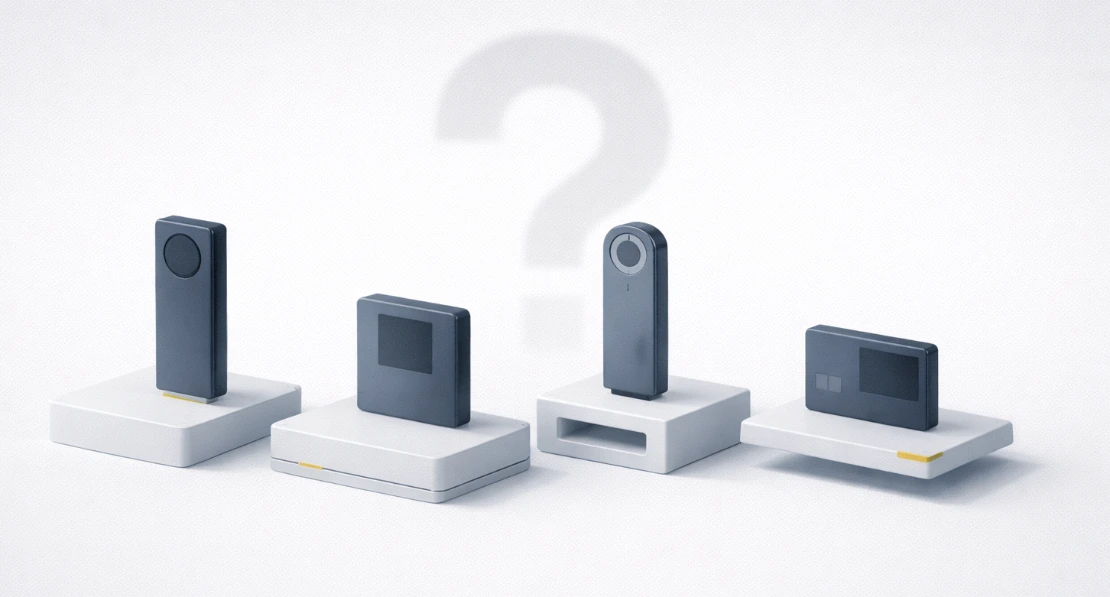
Hardware wallets do not compete on a single axis. They reflect different assumptions about trust, isolation, and interaction. Understanding those assumptions makes comparisons easier to read, and helps avoid being distracted by surface features.
Security is not a single feature
Hardware wallets are often described as secure by default, but that hides the real design work.
Security comes from several choices working together: key isolation, transaction verification, update mechanisms, and the way the device interacts with other software.
No single element guarantees protection on its own. To compare devices properly, you need to look at how these elements support each other.
Key isolation and execution environment
A central question is where keys are handled, and what kind of code can reach them.
Some devices use dedicated secure components. Others rely on isolated execution environments. Both approaches try to limit access to sensitive material.
The design differs, but the objective remains the same: keeping keys unreachable.
Transaction verification and user interface
A hardware wallet asks the user to confirm actions. What appears during that confirmation matters.
A useful verification screen should clearly show amounts, destinations, and contract interactions. This reduces reliance on the connected computer or phone. If the user cannot understand what is being signed, isolation loses much of its value. This is especially important when interacting with smart contracts, where the action being approved may be less obvious than a simple transfer.
Understanding exactly what is being authorized becomes even more important in environments that rely on permissions and approvals. See Approvals and permissions for a closer look at what users often sign without realizing it.
Connectivity and interaction model
Hardware wallets interact with other devices through different models: USB, Bluetooth, or air-gapped workflows.
Each model brings different assumptions. Connectivity affects convenience, but it also affects how much the surrounding environment must be trusted.
A comparison should not stop at the connection type. It should ask how the device communicates, what information moves between systems, and where the user is expected to verify intent.
Software ecosystem and updates
Hardware wallets do not operate alone. They depend on companion software, firmware, and update processes.
Updates matter because they are how bugs are fixed and new features are introduced. They are also a trust channel. Understanding how updates are delivered, verified, and installed is part of understanding long-term risk.
Recovery and compatibility
Hardware wallets rely on recovery mechanisms. Seed phrase standards and wallet compatibility affect what happens if a device fails, is lost, or disappears from the market.
Interoperability is not only about convenience. It also affects resilience. If a wallet manufacturer, software provider, or service disappears, recovery standards and compatibility determine whether users can continue accessing their assets. See If a service disappears for a broader look at this type of dependency.
Comparing without ranking
Comparisons are useful when they clarify trade-offs. They become misleading when they imply a universal winner.
Hardware wallets should be evaluated based on how keys are isolated, how actions are verified, how software evolves, and how recovery works.
Context determines which trade-offs matter most.
Why comparison never changes what the system accepts
Comparing hardware wallets does not change how transactions are validated.
Whatever the device design, the protocol evaluates the resulting signature in the same way. A valid signature is accepted. An invalid one is rejected.
The differences between devices exist before that moment. They affect how keys are isolated, how information is shown to the user, and how updates are delivered.
Once a signature is produced, those differences disappear from the protocol's perspective. The system does not know which device generated it, or under which conditions.
That is why comparisons clarify exposure and trust assumptions, not protocol-level safety. The system enforces outcomes. Devices influence how authority can be exercised.

Key takeaways
- Security is the result of how design choices interact, not the sum of individual features.
- Verification interfaces matter as much as hardware components. If you cannot read what you are signing, isolation is not enough.
- Connectivity reflects trust assumptions. Each interaction model changes what the surrounding environment must be trusted to do.
- Updates are a trust channel. How firmware is delivered and verified is part of the security picture.
- Comparisons should clarify trade-offs, not rank devices.
Find out more
- Hardware wallets : revisits how isolation works at a high level.
- Which crypto wallet should you choose? : connects wallet criteria with personal context.
- Using a hardware wallet : focuses on setup and daily interaction patterns.
- Backup and recovery : explains what recovery means when a wallet is lost, damaged, or replaced.
- If a service disappears : explores what happens when a provider, application, or manufacturer is no longer available.
- Securing your computer and phone for crypto use : explains why the surrounding devices still matter, even with a hardware wallet.
- How to structure your crypto setup and reduce your exposure : helps build a more resilient overall setup.
- How to level up your crypto security : provides practical ways to strengthen your security beyond wallet selection.
CryptKi Academy full index - Browse all articles
Some tools exist to help manage private keys.
If you want to see concrete examples, you can explore our shop.